
Miami County Court Records After Arrest
After a Miami County jail arrest, the jail record and the court record are related but separate. The jail side starts with custody facts, such as booking number, booked-on date, arrest date, arresting agency, arresting officer, holds, and release date. The court side starts when the prosecutor files charges in the Miami County courts or when a warrant case is updated after the arrest. That filed court record is where charge names, statute references, hearings, bond terms, amended counts, dismissals, pleas, trial dates, and final dispositions are tracked.
The distinction matters because the arrest allegation on a jail profile is not the final court charge. For current custody, booking data, and jail holds, use Miami County jail inmate records. For the photo slot and booking-photo access issues, use Miami County jail mugshots. For the formal case after arrest, start with Indiana MyCase, then use the Clerk, Prosecutor, APRA request process, IDOC, BOP, or ICE when the record question falls outside the public case portal.
Find Miami County Court Records
Miami County criminal cases are searched through Indiana MyCase. The Indiana Judicial Branch Miami County court page links users to MyCase and identifies Miami County as part of Judicial District 8. MyCase is public access for non-confidential case information and some documents, but the Judicial Branch help material warns that it is not a complete criminal-history search, may not include every court, and may not reach all older records.
The most reliable search starts with facts from the jail record: name spelling, birth date, booking date, arresting agency, and any case or hold clues. Then search MyCase by party or by case number. If the case is new, a same-day absence from MyCase does not prove that no charges will be filed. Prosecutor review, clerk processing, confidentiality rules, or portal timing can all affect when a Miami County court record becomes visible.
| Field Label / Search Type | Type | Required | Options / Format Notes |
|---|---|---|---|
| Case | Search mode | One search basis required | Search by case number, citation number, or cross-reference number. |
| Party | Search mode | One search basis required | Use business name or last name plus first name, middle name, or date of birth. |
| Attorney | Search mode | One search basis required | Search by attorney number or by last name plus first or middle name. |
| County/Court filters | Dropdown/filter | Optional or varies | Use Miami County or the specific court filter where available. |
| Case type/status filters | Dropdown/filter | Optional or varies | Portal controls can change, so check the live form before relying on a narrow filter. |
The official MyCase search tips say searches can be made by Case, Party, or Attorney and that no search returns more than 1,000 results. Public access is free for many case records and documents.
Miami County Arrest to Court Record
The path is usually arrest, booking, first court review, prosecutor filing, and then case activity. The Miami County Prosecutor is the local official who files formal criminal charges for the State of Indiana. The county prosecutor page describes that office as representing the interests of Miami County and the State of Indiana by enforcing the Indiana Criminal Code. Indiana counties use elected prosecutors, not district attorneys.
- Confirm the jail booking in INjail when the person is still in Miami County Detention Facility custody.
- Open MyCase and search by party name, date of birth, or a case number from jail, warrant, bond, or summons paperwork.
- Open the criminal case and compare the defendant, filing date, court, charge list, case status, and hearing entries.
- Read each charge separately because one case can have pending, amended, dismissed, and disposed counts at the same time.
- If the record is missing or old, contact the Miami County Clerk and ask how to request the case document.
The official screenshot set includes the Indiana MyCase search portal used for charges after arrest.
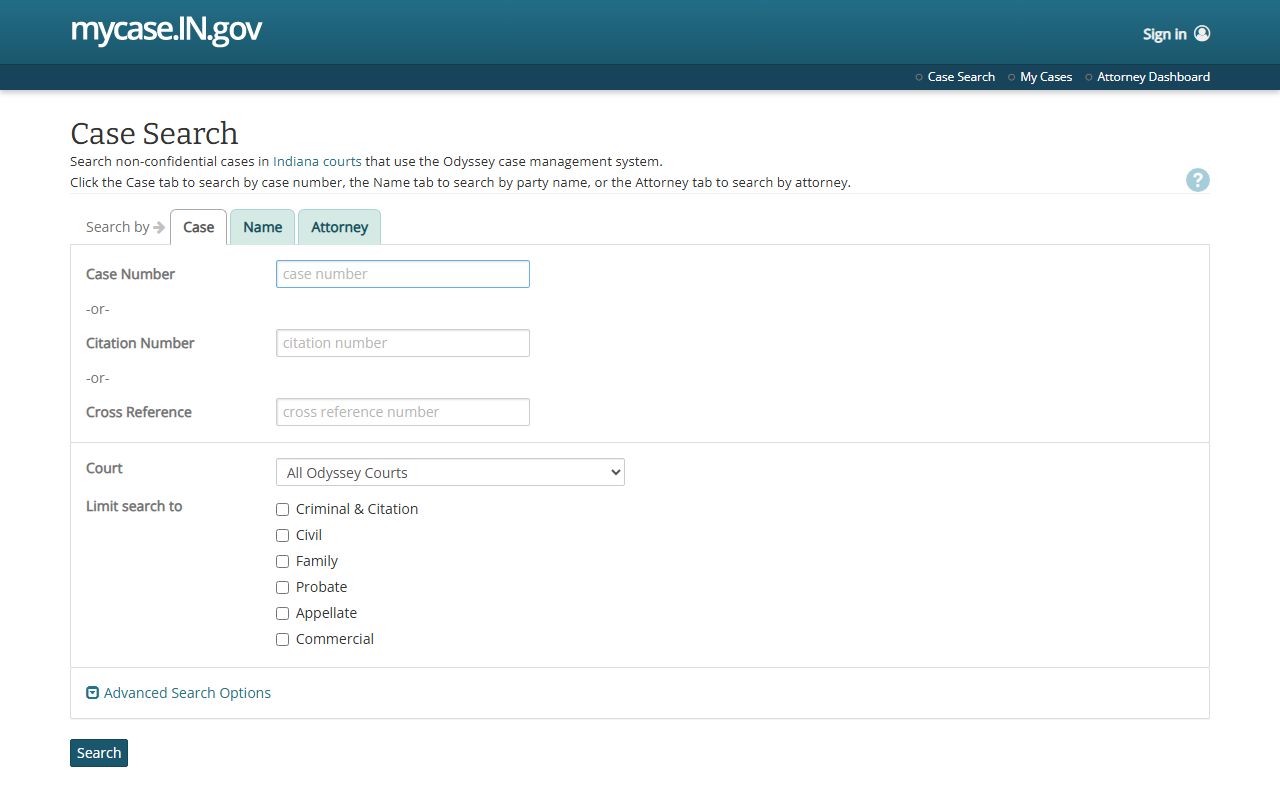
The MyCase portal should be read as a court index and document access point, not as a substitute for the Miami County jail roster or a statewide criminal-history report.
Miami County Charging Documents
A charging document is the paper that turns an arrest allegation into a court case. In Miami County, the prosecutor may file a charge that matches the arrest allegation, may file a different count, or may decide not to file a count listed near booking. A later amended charge can change the level or wording of the accusation. This is why court records after a jail arrest should be checked after the jail roster, not treated as the same record.
| Document | Who Files or Issues It | What It Usually Means |
|---|---|---|
| Complaint | Law enforcement or prosecutor, depending on case practice | Initial allegation or charging paper that can start a criminal case. |
| Information | Prosecutor | Formal prosecutor-filed charge often used in Indiana criminal cases. |
| Indictment | Grand jury | Grand-jury charge, less common for routine county filings. |
When reading a Miami County charge list, compare the charge name, statute, level, filing date, and disposition field. A dismissed count is not a conviction. A pending count is still unresolved. A conviction requires a plea, verdict, or other final adjudication, and the exact outcome should be verified in the court record.
Miami County Charge Status
Charge status is one of the most useful parts of a court record after arrest. It tells whether a count is still active, changed, dropped, or resolved. A single Miami County case may include several counts with different statuses. Bond entries and hearing entries can also change while charges remain pending. Jail release does not equal dismissal, and jail custody does not equal conviction.
| Status | What It Means |
|---|---|
| Pending | The charge remains open and has not reached a final court disposition. |
| Amended | The prosecutor or court changed the charge wording, level, or statutory basis. |
| Reduced | The filed count was lowered to a lesser offense or lower level. |
| Dismissed | The count was dropped by prosecutor or court action and is not a conviction. |
| Convicted | The defendant was found guilty or entered a guilty plea on that count. |
| Diversion / Deferral | The case may be routed through a program or delayed disposition when authorized. |
| Point to Compare | Charge | Conviction |
|---|---|---|
| Meaning | An accusation filed in court after arrest or warrant action. | A final guilty plea, verdict, or adjudication on a count. |
| Where to verify | MyCase charge list, filing entries, and prosecutor filings. | MyCase disposition, judgment, sentencing, or clerk record. |
| Jail roster value | May show the booking allegation or case clue. | Does not prove conviction by itself. |
| Record impact | Can remain pending, be amended, or be dismissed. | Can affect sentencing, IDOC transfer, and criminal-history records. |
Bond and Warrants After Arrest
Bond and warrant entries can appear in both jail and court workflows, but the court controls release conditions. Miami County's official detention page includes a remote GovPay bond prompt for debit or credit card payment, but the research did not locate a full local fee schedule, refund rule, bond window schedule, or accepted in-person payment list. Before paying, confirm the person is in Miami County Detention Facility custody and check whether any hold blocks release.
No official Miami County Sheriff active-warrant search page was found in the county sources. If a warrant led to arrest, the jail record may show the booking and holds after the person is taken into custody. The underlying warrant or bench-warrant status should be checked through MyCase, the issuing court, or the Miami County Clerk. Central Dispatch is for law-enforcement routing, not routine document lookup.
| Issue | Best Source | Miami County Detail |
|---|---|---|
| Bond amount or court condition | MyCase or Clerk | The court order controls what jail staff can accept. |
| Remote bond payment | County detention page | GovPay is linked for some debit or credit card bond payments. |
| Bench warrant | MyCase or court | Often tied to failure to appear or violation of a court order. |
| Hold or detainer | Jail plus issuing agency | May involve DOC, probation, parole, another county, ICE, or federal custody. |
Miami County Court Record Channels
Not every court-record question has the same source. MyCase is the first public case-search tool, but Miami County records may also require clerk contact, prosecutor contact, an APRA request, or a different custody locator. The Indiana courts public-records request help explains that MyCase is not a complete criminal-history search and that older or unavailable documents may need a records request.
| Need | Channel | Miami County Use |
|---|---|---|
| New criminal case after arrest | MyCase party search | Search by last name plus first, middle, or date of birth, then narrow to Miami County when possible. |
| Older or unavailable documents | Miami County Clerk | Clerk Sherry Raber, 25 N Broadway Room 208, Peru, IN 46970, 765-472-3901 x256. |
| Who filed the charges | Miami County Prosecutor | Criminal Division, 25 N Broadway Room 116, Peru, 765-472-3804. |
| Booking record or mugshot not online | Sheriff APRA request | Contact Miami County Sheriff's Office/Jail and ask for the records custodian process. |
| State prison after sentencing | IDOC locator | Use for sentenced Indiana prisoners, including Miami Correctional Facility. |
| Federal or immigration custody | BOP or ICE ODLS | Use when the Miami County jail roster no longer covers the custody status. |
Sealed and Expunged Records
Indiana's Access to Public Records Act, IC 5-14-3, is the main public-records law for agency records unless a valid exception applies. The right to inspect and copy public records is relevant when requesting booking, jail, or court records not posted online. The exceptions section matters too because law-enforcement investigatory records, juvenile information, confidential records, sealed matters, and other protected material may be withheld or redacted.
For record clearing, IC 35-38-9 is the Indiana chapter tied to expungement and sealing of eligible arrest, charge, and conviction records. A sealed or expunged court case should not be treated as a simple website-removal request. The court process controls what can be hidden from public access, while downstream jail, court, and third-party copies may require separate legal review.
| Comparison | Sealed | Expunged |
|---|---|---|
| Basic effect | Public access is restricted by court action. | Eligible records are cleared under the statutory expungement process. |
| Best starting point | Review the court case and sealing order. | Review eligibility under IC 35-38-9 and court procedure. |
| Jail roster impact | Public jail details may be limited when the law requires it. | Do not assume every historical copy disappears without a legal step. |
| Who can advise | Court clerk can route records questions but cannot give legal advice. | An attorney can assess eligibility and filings. |
Note: MyCase, INjail, IDOC, BOP, ICE, the Clerk, and the Prosecutor each keep different records, so sealing in one system should be verified with the originating office.